Whats-Earth's Quasi-Moon 2026–2047: Kamoʻoalewa, the Ghost Moon
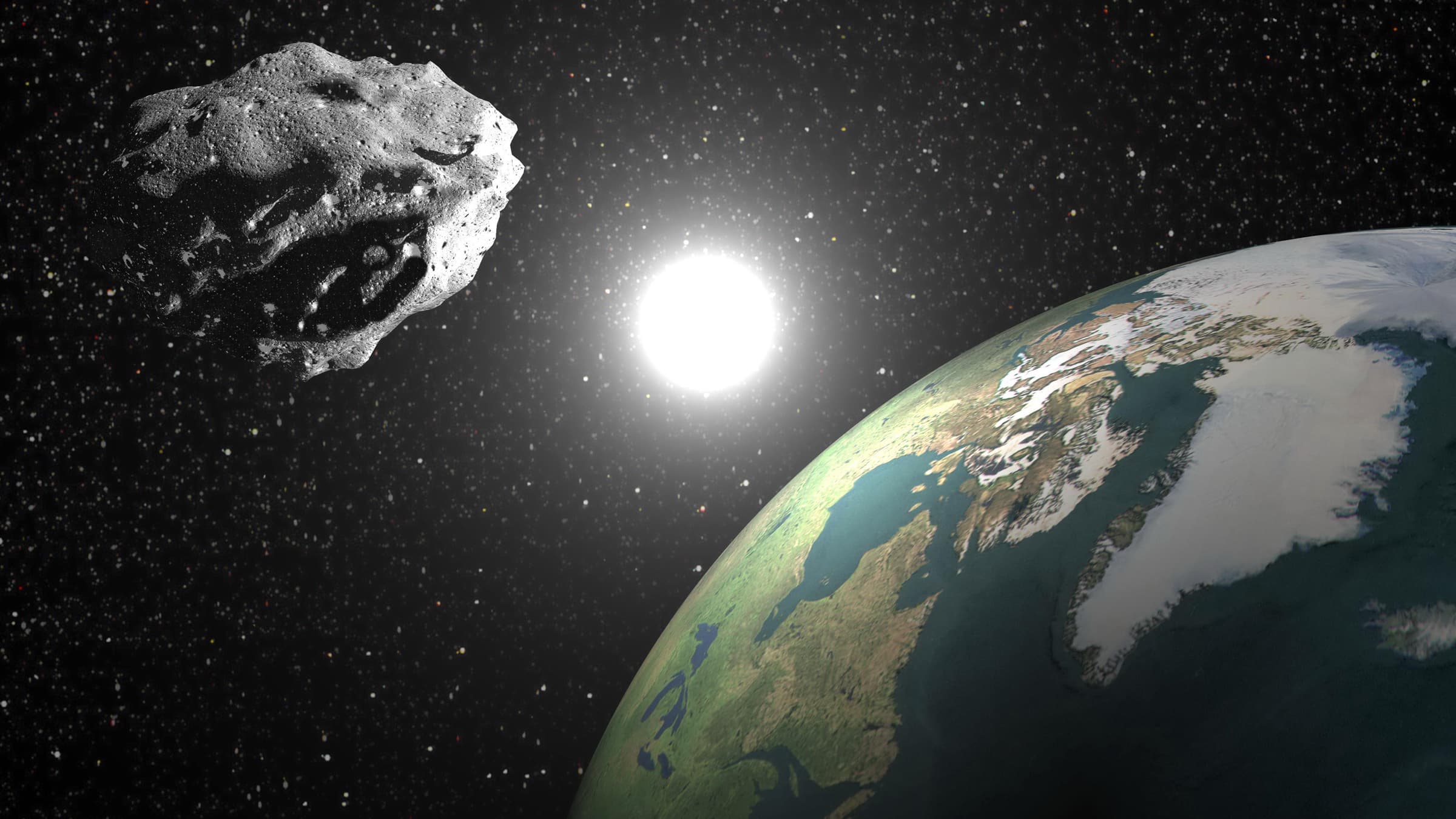
Earth's Quasi-Moon 2026–2047: Kamoʻoalewa, the Ghost Moon Earth has a temporary companion in space apart from the Moon: a small rocky object called a quasi-moon. This object, officially named 2016 HO₃ and nicknamed Kamoʻoalewa, follows a peculiar orbit that makes it appear to circle Earth even though it actually orbits the Sun. Between 2026 and 2047, Kamoʻoalewa will remain in this quasi-moon state, offering astronomers a rare opportunity to study a natural satellite that is not truly bound to our planet.
What is a Quasi-Moon? A quasi-moon is a small celestial body that shares Earth's orbit around the Sun but remains gravitationally influenced by our planet in a way that makes it appear to loop around us. Unlike the Moon, which is permanently bound to Earth by gravity, a quasi-moon orbits the Sun in a 1:1 resonance with Earth, meaning it completes one revolution around the Sun in the same time Earth does.
The term "quasi-moon" describes the apparent motion of these objects from Earth's perspective. When viewed from our planet, they trace a horseshoe or tadpole-shaped path in the sky, creating the illusion of orbiting Earth. However, they are not true satellites because they do not reside within Earth's Hill sphere—the region where our planet's gravity dominates over the Sun's.
Kamoʻoalewa became the first known Earth quasi-moon when it was discovered in 2016 by the Pan-STARRS telescope in Hawaii. Its orbit keeps it within about 38 times the Earth-Moon distance, making it our closest known quasi-satellite. The object measures between 40 and 100 meters in diameter, roughly the size of a football field.
How Does a Quasi-Moon Orbit Differ from the Moon? The Moon orbits Earth at an average distance of 384,400 kilometers, completing one revolution every 27.3 days. Its path is stable and predictable, governed entirely by Earth's gravitational pull. In contrast, a quasi-moon like Kamoʻoalewa follows a much more complex trajectory.
Kamoʻoalewa orbits the Sun at nearly the same distance as Earth, maintaining a gravitational dance that keeps it in our vicinity. Its orbital period is approximately 365.9 days, just slightly longer than Earth's year. This slight difference creates a drift that causes the object to appear to circle Earth from our perspective, completing one apparent loop every 365 days.
The quasi-moon's path forms a distinctive pattern in the sky. When plotted in a rotating reference frame that moves with Earth, the object traces what astronomers call a "horseshoe orbit." This pattern emerges because the object alternates between moving slightly faster and slightly slower than Earth, creating a back-and-forth motion relative to our planet.
Will Earth's Quasi-Moon Be Visible? Under exceptional circumstances, Kamoʻoalewa might be visible to the naked eye, but only under ideal conditions. The object's apparent magnitude typically ranges between 20 and 23, making it far too dim for casual observation. Professional telescopes are required to track its position accurately.
The quasi-moon becomes slightly brighter during its closest approaches to Earth, which occur roughly every year. Even at these moments, it remains beyond the reach of unaided human vision. Amateur astronomers with moderate-sized telescopes (8 inches or larger) may be able to spot it under dark sky conditions, though locating it requires precise coordinates and patience.
Kamoʻoalewa's visibility is further complicated by its orbital position. It spends most of its time near the Sun from Earth's perspective, making observation difficult due to solar glare. The best viewing windows occur when the object reaches maximum elongation—the point where it appears farthest from the Sun in the sky. These windows typically last only a few weeks each year.
How Big is a Quasi-Moon? Quasi-moons vary significantly in size depending on their origin and composition. Kamoʻoalewa, Earth's current quasi-moon, measures between 40 and 100 meters across. This places it in the category of small near-Earth asteroids rather than substantial moons.
For comparison, the Moon has a diameter of 3,474 kilometers, making it over 34 times larger than Kamoʻoalewa at minimum and 86 times larger at maximum. The quasi-moon's size is more comparable to a large building or small sports stadium than to any natural satellite we typically imagine.
The size of a quasi-moon is determined by multiple factors, including its formation history and the gravitational dynamics that allow it to maintain its quasi-satellite status. Smaller objects are more easily perturbed by the gravitational influence of other planets, particularly Jupiter, which can disrupt their orbits over time. Larger quasi-moons would be more stable but are also rarer due to the specific orbital mechanics required.
Have We Had a Quasi-Moon Before? Kamoʻoalewa is not Earth's first quasi-moon. Astronomers have identified several other objects that have temporarily occupied quasi-satellite orbits around our planet. The dynamic nature of near-Earth space means that quasi-moons can be captured and released over timescales ranging from decades to centuries.
One notable predecessor was 2014 UN₂₇, which briefly exhibited quasi-satellite behavior before transitioning to a different orbital class. Another object, 2006 FV₃₅, demonstrated quasi-moon-like characteristics for a limited period before its orbit evolved. These temporary captures highlight the fluid nature of gravitational relationships in the inner solar system.
The Japanese space agency JAXA has identified several additional candidates that may have acted as quasi-moons in the past or could do so in the future. These objects typically spend only a few decades in quasi-satellite configuration before gravitational perturbations from other celestial bodies alter their trajectories.
Kamoʻoalewa: The Ghost Moon Kamoʻoalewa earned its nickname "ghost moon" from the Hawaiian language, where it translates to "oscillating treasure." This poetic name reflects both the object's elusive nature and its scientific value. The moniker "ghost moon" has gained traction in popular science communication, capturing the public imagination with its mysterious connotations.
The ghost moon designation emphasizes the object's ethereal presence in Earth's vicinity. Unlike the familiar Moon that dominates our night sky, Kamoʻoalewa remains hidden from casual observation, appearing and disappearing from our telescopic view like a phantom companion. Its quasi-orbital path creates the illusion of a moon that never truly settles into a fixed position.
Kamoʻoalewa's ghost-like qualities extend beyond its visibility. The object's orbit is inherently unstable on astronomical timescales. Within a few hundred years, gravitational interactions with other planets will likely eject it from its current configuration, sending it into a different orbital class or even out of the inner solar system entirely. This transient nature reinforces its ghostly characterization.
The Science Behind Quasi-Moon Orbits The orbital mechanics that enable quasi-moon behavior involve complex gravitational interactions between the Sun, Earth, and the object itself. These dynamics operate within what astronomers call the three-body problem, where the motion of three gravitationally interacting bodies produces intricate and often unpredictable trajectories.
For an object to maintain quasi-satellite status, it must occupy a specific region of phase space known as a Lagrange point vicinity. These are positions where the combined gravitational forces of the Sun and Earth create stable or semi-stable equilibrium points. Kamoʻoalewa resides near the L₄ and L₅ Lagrange points, which are located 60 degrees ahead of and behind Earth in its orbit.
The stability of these orbits depends on the object's distance from Earth and its orbital eccentricity. Objects that venture too close to Earth risk being captured as true satellites or colliding with our planet. Those that drift too far away succumb to the Sun's dominant gravitational influence and escape the quasi-satellite configuration.
How Long Will Kamoʻoalewa Remain a Quasi-Moon? Kamoʻoalewa's current quasi-satellite phase began around 2016 and is expected to continue until approximately 2047. This 31-year window represents a temporary configuration that emerged from the object's natural orbital evolution. After this period, gravitational perturbations will likely alter its trajectory significantly.
The Japanese space agency JAXA has conducted extensive simulations to predict Kamoʻoalewa's future behavior. Their models suggest that the object may transition into a horseshoe orbit after 2047, where it would oscillate between trailing and leading Earth in its solar orbit. This configuration would persist for several centuries before another orbital transition occurs.
The timescale of Kamoʻoalewa's quasi-moon phase is typical for objects of its size and orbital characteristics. Smaller quasi-moons tend to have shorter residence times due to their susceptibility to gravitational perturbations. Larger objects, if they exist, could potentially maintain quasi-satellite status for thousands of years.
The Discovery of Kamoʻoalewa Kamoʻoalewa was discovered on April 27, 2016, by the Panoramic Survey Telescope and Rapid Response System (Pan-STARRS) located at Haleakalā Observatory in Hawaii. The Pan-STARRS project conducts systematic surveys of the sky to detect near-Earth objects, including asteroids and comets that could potentially pose impact hazards.
The discovery team, led by astronomers at the University of Hawaii, initially classified the object as a near-Earth asteroid. Subsequent orbital analysis revealed its unique quasi-satellite configuration, prompting reclassification as Earth's first known quasi-moon. The finding was published in the journal Icarus and generated significant interest within the astronomical community.
The naming process for Kamoʻoalewa involved collaboration between scientists and Hawaiian cultural experts. The chosen name honors the object's oscillating nature while respecting the indigenous heritage of the discovery location. This cultural sensitivity in scientific nomenclature has become a model for future astronomical naming conventions.
Could Other Planets Have Quasi-Moons? Quasi-moons are not unique to Earth. Other planets in our solar system can and do host quasi-satellites, though the dynamics vary depending on each planet's mass, orbital distance, and gravitational environment. Venus, Mars, and the gas giants have all been observed with temporary quasi-satellites.
Venus has hosted several known quasi-moons, including 2002 VE₆₈, which has maintained a quasi-satellite configuration for thousands of years. This object's longevity is attributed to Venus's orbital characteristics and the stabilizing influence of its gravitational field. Mars has also been observed with temporary quasi-satellites, though these tend to be shorter-lived due to the planet's smaller mass.
The gas giants—Jupiter, Saturn, Uranus, and Neptune—possess vast gravitational spheres of influence that can capture and retain quasi-satellites for extended periods. Neptune's quasi-moons, in particular, have been studied extensively due to their role in the dynamics of the Kuiper Belt. These objects provide insights into the formation and evolution of the outer solar system.
What if Earth Had 1,000,000 Moons? The hypothetical scenario of Earth possessing one million moons presents fascinating gravitational and astronomical implications. However, such a configuration is physically impossible under current solar system dynamics. The gravitational stability required to maintain even a fraction of that many satellites exceeds what Earth's mass can support.
The Moon currently dominates Earth's satellite system, accounting for over 99% of the total mass in orbit around our planet. Adding additional moons would require either capturing them from elsewhere in the solar system or forming them from debris in Earth's vicinity. Both scenarios face significant physical constraints.
Even if one million small moons the size of Kamoʻoalewa could theoretically exist, their collective gravitational influence would destabilize the entire system. The Moon's orbit would be perturbed, potentially leading to collisions or ejections. The night sky would be dramatically altered, with countless points of light visible to the naked eye.
From an observational standpoint, one million moons would create a spectacular celestial display. However, the practical implications for life on Earth would be severe. Increased tidal forces, altered orbital mechanics, and enhanced meteorite impact rates would likely render the planet uninhabitable.
What Planet Has a 99.7% Chance of Life? The claim that any planet has a 99.7% probability of hosting life requires careful examination. No exoplanet currently meets this threshold of certainty based on available scientific evidence. The search for extraterrestrial life remains in its early stages, with most assessments based on indirect indicators rather than direct detection.
Some exoplanets have been identified as potentially habitable based on their location within their star's habitable zone—the region where liquid water could exist on the surface. Candidates include Proxima Centauri b, TRAPPIST-1e, and TOI-700 d. However, habitability does not equate to the presence of life, and even the most promising candidates lack confirmed biosignatures.
The 99.7% figure likely originates from statistical models rather than empirical observations. These models estimate the probability of life based on factors such as planetary mass, orbital distance, stellar type, and atmospheric composition. While useful for prioritizing targets for future observation, they cannot definitively confirm the existence of life.
Quasi-Moons and Space Exploration The study of quasi-moons has practical implications for space exploration and planetary defense. These objects represent potential targets for future missions due to their relatively accessible orbits and scientific value. Japan's space agency JAXA has proposed a mission to Kamoʻoalewa, which would mark the first dedicated exploration of a quasi-moon.
The proposed Hayabuse3 mission aims to visit Kamoʻoalewa, collect samples, and return them to Earth for analysis. This mission would provide unprecedented insights into the composition and origin of near-Earth objects. The data gathered could inform future asteroid mining operations and planetary defense strategies.
Quasi-moons also serve as natural laboratories for studying orbital dynamics and gravitational interactions. Understanding their behavior improves our ability to predict the trajectories of potentially hazardous asteroids and plan efficient spacecraft navigation routes. The knowledge gained from quasi-moon research has applications ranging from mission planning to impact hazard assessment.
Observing Quasi-Moons: Challenges and Opportunities Tracking quasi-moons presents unique challenges for astronomers. Their small size, dim appearance, and complex orbital paths require sophisticated observation techniques and advanced computational modeling. Professional observatories equipped with large-aperture telescopes and sensitive detectors are essential for maintaining accurate ephemerides.
The European Space Agency's Near-Earth Object Coordination Centre and NASA's Center for Near-Earth Object Studies continuously monitor known quasi-moons to update their orbital parameters. These organizations maintain databases that track the positions and trajectories of thousands of near-Earth objects, including quasi-satellites.
Amateur astronomers can contribute to quasi-moon research by participating in citizen science projects and reporting observations to professional organizations. The Minor Planet Center coordinates these efforts, providing a platform for amateur and professional astronomers to share data and collaborate on discovery efforts.
Future of Quasi-Moon Research The field of quasi-moon research is rapidly evolving as new telescopes and survey instruments come online. The Vera C. Rubin Observatory, scheduled to begin operations in the mid-2020s, will conduct systematic surveys of the sky with unprecedented sensitivity. This facility is expected to discover dozens of new quasi-moons and other near-Earth objects.
The James Webb Space Telescope and other next-generation observatories will enable detailed spectroscopic analysis of quasi-moons, revealing their composition and physical properties. These observations will help determine whether quasi-moons share characteristics with other near-Earth asteroids or represent a distinct population.
International collaboration remains essential for advancing quasi-moon research. The Global Electro-Optical Infrared System (GEO-IR) and other multinational networks facilitate data sharing and coordinated observations. These partnerships ensure comprehensive coverage of the sky and maximize the scientific return from limited observational resources.
Conclusion Earth's quasi-moon Kamoʻoalewa represents a fascinating chapter in our understanding of celestial mechanics and near-Earth space. This ghost-like companion, oscillating between Earth and the Sun, offers scientists a unique opportunity to study orbital dynamics, asteroid composition, and the gravitational interactions that shape our solar system. As research continues and new quasi-moons are discovered, humanity's knowledge of these ephemeral companions will deepen, revealing new insights into the cosmic dance of planets and asteroids.
FAQ Section What is a quasi-moon? A quasi-moon is a celestial object that orbits the Sun in resonance with Earth, creating the appearance of circling our planet from our perspective. Unlike true moons, quasi-moons are not gravitationally bound to Earth but remain in its vicinity due to orbital dynamics.
Will Earth's quasi-moon be visible to the naked eye? Under normal circumstances, Earth's quasi-moon Kamoʻoalewa is not visible to the naked eye. Its apparent magnitude is too dim (between 20 and 23) for unaided observation. Professional telescopes are required to track its position accurately.
How big is a quasi-moon? Quasi-moons vary in size, but Earth's current quasi-moon Kamoʻoalewa measures between 40 and 100 meters in diameter. This is significantly smaller than the Moon, which has a diameter of 3,474 kilometers.
Have we had a quasi-moon before? Yes, Earth has hosted other quasi-moons in the past. Objects like 2014 UN₂₇ and 2006 FV₃₅ have exhibited quasi-satellite behavior, though these configurations are typically temporary and last only a few decades.
What is the ghost moon? The ghost moon is the nickname for Kamoʻoalewa (2016 HO₃), derived from the Hawaiian phrase meaning "oscillating treasure." The name reflects the object's elusive, quasi-orbital nature and its scientific value.
How long will Kamoʻoalewa remain Earth's quasi-moon? Kamoʻoalewa's current quasi-satellite phase is expected to continue until approximately 2047. After this period, gravitational perturbations will likely alter its trajectory, potentially transitioning it to a different orbital configuration.
Can other planets have quasi-moons? Yes, other planets can and do host quasi-moons. Venus, Mars, and the gas giants have all been observed with temporary or permanent quasi-satellites, depending on their gravitational environments and orbital characteristics.
Related Topics
About admin
SEO expert and content strategist helping businesses grow their online presence through data-driven strategies.