Lakes That Explode Without Warning: Limnic Eruption Science
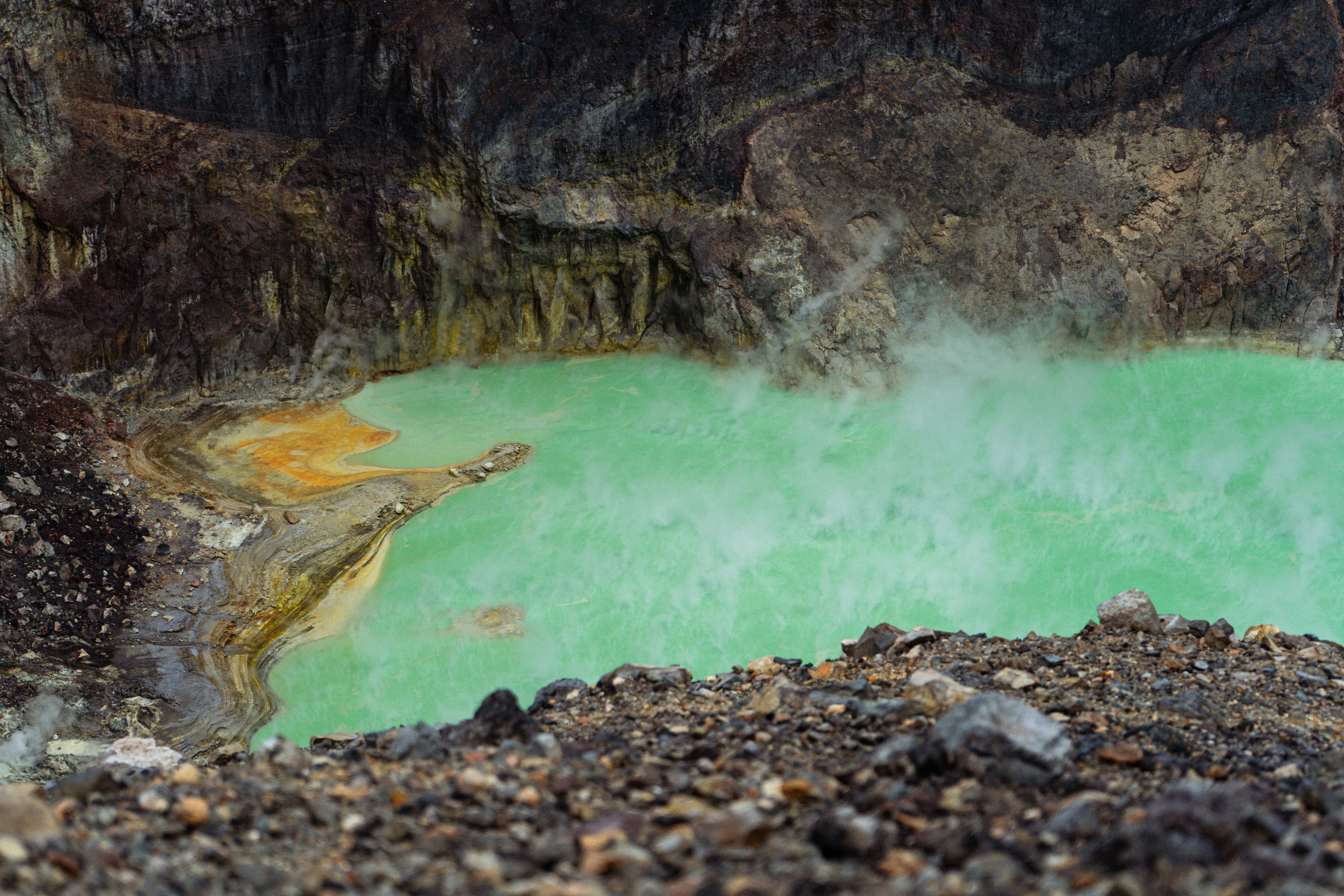
Introduction – The Invisible Dangers Beneath Tranquil Lakes Lakes may look calm, but a few hide a deadly secret: massive amounts of dissolved CO₂ trapped at depth. When this gas suddenly bursts free, it creates a limnic eruption – a gas “explosion” that can asphyxiate everything nearby. Only three lakes on Earth are known to be capable of such eruptions: Cameroon’s Lake Nyos and Monoun, and Lake Kivu on the Rwanda/Democratic Republic of Congo border. These lakes sit atop volcanic areas and are deep and meromictic, meaning the bottom layer never mixes with the surface. Over decades, volcanic CO₂ seeps in and accumulates under a natural “cork” of warm surface water. In 1986 Lake Nyos suddenly released up to 300,000 tons of CO₂, and a heavy gas cloud flowed down valleys, suffocating 1,746 people and 3,500 livestock in nearby villages. That shocking event first alerted scientists to this phenomenon.
How does a lake ‘explode’? Because the deep water is much colder and denser, it stays separate from the warm surface water. Magmatic CO₂ slowly dissolves into the lake’s bottom. The lake can hold huge dissolved CO₂ loads without issue, until a sudden trigger (like a landslide, earthquake or unusually heavy rain) disturbs the balance. When a pocket of gas-rich deep water rises to shallower depth, the pressure drops, CO₂ comes out of solution and forms bubbles. Those bubbles make the water buoyant, causing more deep water to rise and release more gas in a runaway cascade – much like a shaken champagne bottle popping its cork.
Lake Nyos (1986): The Deadly Limnic Eruption. On the night of August 21, 1986, Lake Nyos in Cameroon quietly erupted in CO₂. Eyewitnesses later described a brief fountain of water, but by morning a silent cloud of CO₂ – about 100,000 to 300,000 tons – had poured into downstream valleys. This invisible gas, denser than air, rolled down the hillsides at ~100 km/h, filling homes in the villages of Cha, Nyos, and Subum. By sunrise, 1,746 people and an estimated 3,500 animals lay dead, mostly in their sleep. Scientists determined the CO₂ came from magma beneath the lake; it had dissolved into cold bottom waters until a minor trigger set off the eruption. The Nyos disaster remains the only known major limnic eruption to kill people in modern times. (Its "little sibling" Lake Monoun in 1984 had a smaller burst, killing 37 people.)
Other Known Exploding Lakes (Historical). Limnic eruptions are extremely rare. Besides Nyos and Monoun, the only other modern candidate is Lake Kivu (see below). Some historical accounts suggest similar events long ago. For example, in 406 BC the Roman writer Plutarch described Lake Albano (Italy) surging over its rim without rainfall or tributaries – possibly triggered by CO₂ release. Even Messel Pit fossils in Germany show evidence of a catastrophic gas release in the distant past. These ancient clues hint that the underlying physics can occur whenever a deep lake sits above volcanic rock, even outside Africa.
Lake Kivu – The Silent Giant of Danger. Lake Kivu straddles Rwanda and the DRC and is vastly larger than Nyos (≈1500× its area and 485 m deep). It holds about 300 km³ of dissolved CO₂ and 60 km³ of methane (CH₄) in its deep waters. (By comparison, Nyos held only ~0.07 km³ of CO₂.) Roughly 2–2.5 million people live on Kivu’s shores. Geologists worry a limnic eruption at Kivu would be orders of magnitude worse – a cloud of CO₂ (and possibly toxic CH₄) could engulf a huge area, especially if triggered by an earthquake or volcanic event. Recent studies indicate, however, that Kivu’s gas levels have been relatively steady for decades. A 2020 campaign by multiple institutes found no measurable increase in CH₄ or CO₂ since 1974, concluding the lake is close to a steady-state condition. The Rwanda/DRC government monitors Kivu closely: minor gas releases were observed after a 2021 tremor, but REMA confirmed no imminent eruption risk. Methane extraction projects (e.g. KivuWatt, 26 MW) are actually reducing the gas load while generating electricity. Nevertheless, experts stress that no early-warning system exists – any massive disturbance (landslide, large quake, or lava influx) could still “pop the cork” of Kivu’s deep stratification.
What Causes a Lake to Explode? Limnic eruptions require a permanently stratified lake over volcanic terrain. Key ingredients include:
Steady gas influx: Magma or volcanic soils release CO₂ (and CH₄ from microbes) into the lake bottom over years. Strong thermal stratification: The lake must have a warm, fresh surface layer floating over a cool, dense bottom layer, so the deep gas cannot escape upward normally. Trapping ‘cork’: The surface layer acts like a lid, keeping CO₂ dissolved deep down until saturation. Trigger event: An external shock (earthquake, landslide, heavy rain, volcanic heating) disturbs the lake, allowing bubble formation. Once bubbles start rising, the expanding gas lifts more deep water, causing a chain-reaction gas burst. The Engineering Response – Defusing the Bomb. After Nyos and Monoun, international teams designed a controlled degassing system to vent CO₂ safely. The method is ingenious and surprisingly simple:
Lower a pipe to ~200m depth: A hollow polyethylene pipe (which nearly floats in water) is installed in the CO₂-rich bottom layer. Start water flow: A small pump briefly draws dense water into the pipe. Self-sustaining outflow: As the water rises, the pressure drops and CO₂ comes out of solution, forming a bubbly mixture. Vent at surface: The buoyant water-gas mix shoots to the surface (often as a fountain), and the gas escapes harmlessly into the air. The now-degassed water returns to the lake at shallower depth. This loop then runs on its own without further pumping – like a perpetual fountain. The first permanent degassing pipe at Lake Nyos was started in January 2001 and produced a 50-meter-high fountain. Two more pipes were added by 2011. By that year, Lake Monoun was declared “degassed” (over 90% of its CO₂ removed). At Nyos, only about 33% of the original CO₂ had been vented by 2019, because the lake recharges from below. Scientists estimate that with a few more pipes, Nyos could be made almost completely safe. Continual monitoring is crucial: even with pipes, magma will keep leaking CO₂, so the work must be maintained indefinitely.
FAQs – Answering Your Questions
What causes a lake to explode? In short, a deep lake sitting over volcanic ground can accumulate CO₂ (and methane) in its cold bottom. If this gas-rich layer suddenly mixes with surface water or is disturbed (by an earthquake, landslide, heavy rain, etc.), the pressure drop causes the CO₂ to come out of solution and violently erupt. Essentially the lake “uncorks” like shaking a soda bottle.
How many people died in the Lake Nyos disaster? The 1986 eruption killed approximately 1,746 people and thousands of livestock within minutes. (In 1984, the smaller Lake Monoun eruption killed 37.)
Is Lake Kivu dangerous to live near? Lake Kivu contains far more dissolved gas than Nyos did – enough CO₂ to release gigatons of gas (about 5% of annual global CO₂ emissions). In theory, an eruption there could be catastrophic. However, current data show Kivu’s gas levels are stable and far from triggering on their own. The main risk would be a sudden disruption (e.g. a huge landslide or volcano eruption). For now, engineers are actively harvesting gas (making electricity) and monitoring the lake closely.
Are there exploding lakes outside Africa? No fully modern example is known outside Africa, but geological evidence suggests similar events have happened. As noted, Italy’s Lake Albano surged in 406 BC likely due to gas release, and deep Eocene sediment in Germany (Messel) records an ancient limnic-style disaster. So while rare, the physics can occur elsewhere.
Conclusion: Limnic eruptions – “exploding lakes” – are extremely rare but deadly. Thanks to research and engineering, the CO₂ threat at Lakes Nyos and Monoun is now mitigated. Yet Lake Kivu and a few other gas-charged lakes remain under watch. Scientists around the world use these cases to better understand lake chemistry and improve monitoring. By explaining how dissolved gases accumulate and modeling triggers, researchers hope to give early warning where possible. Until then, communities near such lakes continue to live under the “cork” of pressure, hoping for the best – and the continuing vigilance of geologists and engineers.
Related Topics
About admin
SEO expert and content strategist helping businesses grow their online presence through data-driven strategies.