Bhopal Algae Tree: India’s 1st Air-Purifying Tech
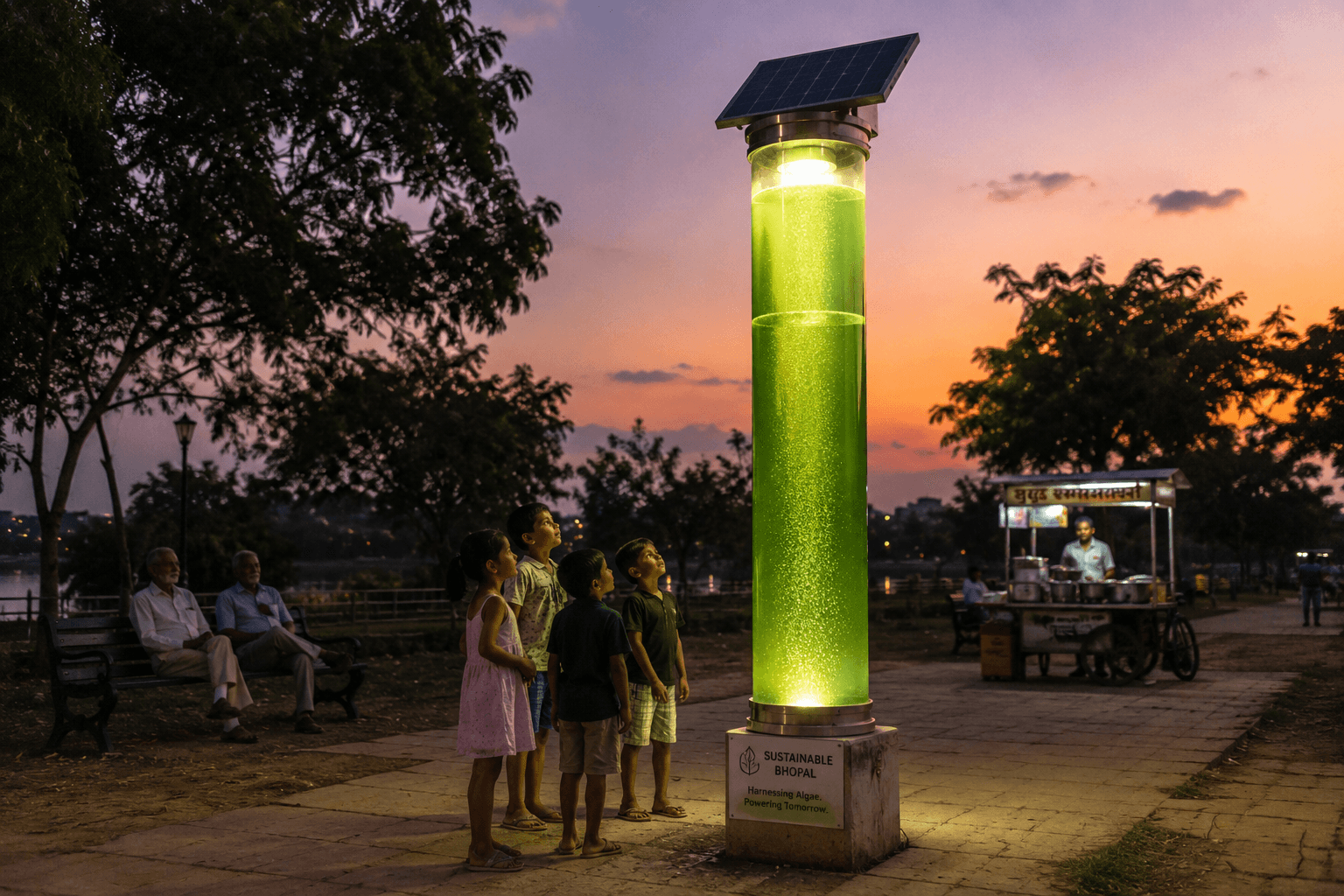
Bhopal has installed India’s first algae tree, a futuristic carbon-capturing system designed to help combat air pollution in the city. The installation is part of the Smart City initiative and has been placed at Swami Vivekananda Park, where it stands as a visible example of urban climate technology. The device uses microalgae to absorb carbon dioxide from the surrounding air and release oxygen back into the environment. Reports describe it as a solar-powered, vertical bio-engineering structure rather than a natural tree, built to function as a compact air-cleaning unit in a public space.
The Bhopal algae tree is based on a photo-bioreactor system that supports the growth and activity of algae inside a controlled chamber. As air enters the system, the microalgae use sunlight and water to carry out photosynthesis, taking in carbon dioxide and generating oxygen. This process allows the device to work as an environmental purifier while also contributing to natural oxygen production. The structure has attracted attention because it combines biology, engineering, and renewable energy in a single installation.
According to published reports, one algae tree unit can absorb around 1.5 tonnes of carbon dioxide each year and produce about 1 tonne of oxygen annually. The device has also been described as having an air-quality benefit within a 15-metre radius, with claims of reducing PM2.5 particles by 45 to 55 percent in its surrounding area. These figures have made the Bhopal installation one of the most discussed environmental technology stories in India.
The algae tree in Bhopal is not a traditional tree, but it is designed to mimic some of the environmental functions associated with trees. Its microalgae-based system continuously processes surrounding air and uses solar energy to power its components. This makes it a low-energy ecological device suited for busy urban settings where space is limited and pollution levels are high. The installation reflects a growing interest in compact, science-based solutions for improving city air.
Bhopal’s algae tree has become notable because it is the first of its kind in India and part of a broader push toward sustainable urban innovation. The project was developed after extensive research and has been positioned as a modern tool for tackling pollution in dense city environments. By using living algae instead of conventional mechanical filtration alone, the technology introduces a biological method of air treatment that can run continuously in public spaces.
The carbon-capturing function of the algae tree is central to its environmental significance. Carbon dioxide is one of the major greenhouse gases linked to global warming, and systems that remove it from the atmosphere are increasingly important in climate mitigation efforts. In Bhopal, the algae tree is being presented as a city-level response to both air pollution and carbon emissions, especially in crowded zones where traffic and dust contribute heavily to poor air quality.
The device also highlights the role of microalgae in clean-air technology. Microalgae are highly efficient at photosynthesis and can grow quickly under controlled conditions, which makes them suitable for environmental applications. In the Bhopal installation, the algae are housed in a structure that allows them to receive light, circulate water, and interact with incoming air. This controlled setup helps the system perform as a living oxygen-producing unit.
The installation has drawn public interest because it presents a new model for urban greenery and pollution control. Instead of depending only on large-scale plantation drives, the algae tree offers a smaller, engineered system that can be placed in parks, roadsides, and other congested locations. Its presence in Swami Vivekananda Park has turned it into a symbol of climate innovation and a showcase for how cities can experiment with bio-based environmental solutions.
The Bhopal algae tree has also gained attention because of its comparison with mature trees. Reports state that one unit is claimed to be as effective as 20 to 25 adult trees in absorbing carbon dioxide and releasing oxygen. While it is still a man-made device rather than a natural ecosystem, the comparison has helped people understand the scale of its environmental output. This is one of the reasons the topic has spread quickly across search engines and news platforms.
In the context of smart cities, the algae tree represents a new direction in infrastructure planning. It shows how environmental devices can be built into public spaces to deliver measurable ecological benefits. Bhopal’s installation has been widely covered because it combines clean-air goals with solar power and biotechnology, making it relevant to discussions about sustainability, climate adaptation, and future urban design.
The algae tree story in Bhopal is also linked to India’s growing focus on air pollution solutions. Cities across the country face seasonal smog, dust, and high particulate matter levels, and there is increasing interest in technology that can help reduce these problems. The Bhopal project has become a reference point in that conversation because it offers a visible, science-driven method for carbon absorption and oxygen generation.
The structure’s solar-powered operation is another important feature. By using solar energy to run lights, pumps, and sensors, the algae tree reduces dependence on conventional power sources. This makes it a cleaner environmental system overall and strengthens its position as a sustainable public technology. The use of sunlight also supports the biological cycle inside the unit, which is essential for algae growth and oxygen output.
Bhopal’s algae tree has become part of a larger conversation about how technology and nature can work together to improve city life. It uses living organisms to process air pollution while occupying very little space, which makes it distinct from traditional landscaping or mechanical air filtration systems. Its installation marks an early stage in the use of algae-based environmental devices in India, and its impact is being closely followed as a model for similar projects in the future.
As a result, the Bhopal algae tree is now one of the most searched environmental innovation topics associated with the city. Queries such as algae tree Bhopal, India first algae tree, Bhopal pollution solution, microalgae air purifier, and carbon-capturing tree have strong relevance in Google search trends because they match current news interest and public curiosity. The topic sits at the intersection of urban pollution control, sustainable technology, and natural oxygen production.
FAQs What is the Bhopal algae tree? The Bhopal algae tree is India’s first algae-based carbon-capturing device installed to help fight air pollution and produce oxygen.
Is the Bhopal algae tree a real tree? No, it is not a natural tree. It is a solar-powered bio-engineering structure filled with microalgae that works as an air-cleaning system.
How does the algae tree work? It uses microalgae inside a controlled photo-bioreactor system to absorb carbon dioxide, release oxygen, and help reduce airborne pollutants.
How much carbon dioxide can one algae tree absorb? Reports say one unit can absorb about 1.5 tonnes of carbon dioxide per year.
How much oxygen does it produce? Published reports state that one unit can generate around 1 tonne of oxygen annually.
Where is the algae tree installed in Bhopal? India’s first algae tree has been installed at Swami Vivekananda Park in Bhopal.
Why is the Bhopal algae tree important? It is important because it introduces a new urban air-purification technology that combines algae, solar energy, and carbon capture.
Related Topics
About admin
SEO expert and content strategist helping businesses grow their online presence through data-driven strategies.

Algae Tree: Natural Oxygen Technology for Cleaner Air
Algae Tree is a new technology that uses algae to produce natural oxygen and support cleaner air in urban environments.
Blood Falls: Antarctica's Bleeding Glacier Mystery
Antarctica's Blood Falls mystery solved after 100 years. Iron-rich saltwater & 2M-year-old trapped microbes.

6G vs 5G network: What Makes 6G 10x Better?
6G is coming with faster speed, lower latency, AI-native networks, and new use cases that go far beyond 5G.

World War 1 vs World War 2: Which Was Worse?
World War II was worse overall than World War I because of higher casualties, greater civilian suffering, and wider global destruction.